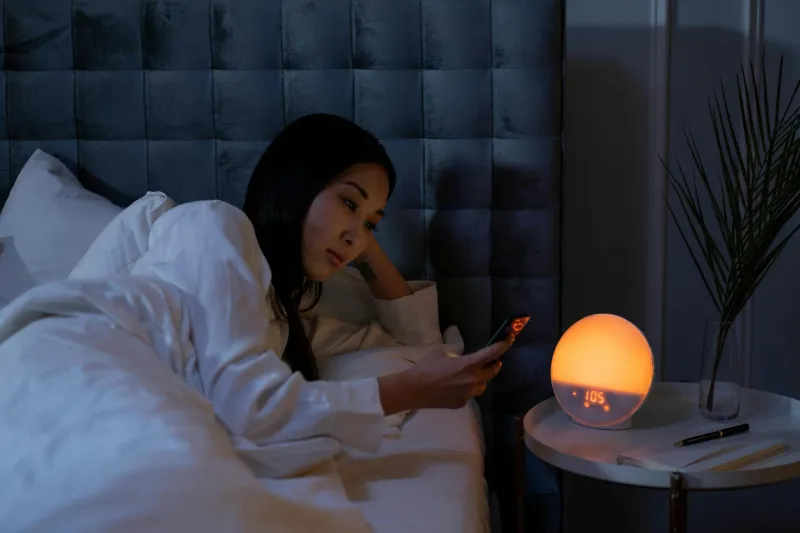
It's 11:47 PM, and you're doing the math. If you fall asleep right now, you'll get exactly seven hours and thirteen minutes of sleep. Not quite the eight hours every health article insists you need. So you lie there, anxiety building, watching the minutes tick away and your sleep window shrink.
Sound familiar? Welcome to the club of orthosomnia sufferers — people whose obsession with perfect sleep is actually ruining their sleep.
When Good Advice Goes Bad
The eight-hour sleep recommendation has become so deeply embedded in wellness culture that it's achieved near-religious status. Fitness trackers celebrate when you hit the target. Sleep apps grade your performance. Social media influencers post screenshots of their "perfect" eight-hour nights like they're sharing report cards.
But here's the twist that sleep researchers have been trying to tell us: this rigid fixation on eight hours is creating a generation of anxious insomniacs who are sabotaging the very thing they're trying to optimize.
Dr. Kenneth Wright, who runs the Sleep and Chronobiology Lab at the University of Colorado Boulder, sees it constantly. "Patients come in worried they're not getting eight hours, but their actual sleep quality is fine. The anxiety about the number has become the problem."
 Photo: University of Colorado Boulder, via cdn.stateuniversity.com
The Individual Sleep Signature
The dirty secret about sleep science? The eight-hour rule was never really a rule at all — it was an average.
When researchers studied large populations, they found that most adults sleep somewhere between seven and nine hours per night. Eight hours fell right in the middle, so it became the target. But averages don't tell individual stories.
Some people are natural short sleepers who function perfectly on six hours. Others need nine or ten hours to feel human. Your optimal sleep duration is written in your genes, influenced by your age, activity level, and countless other factors that have nothing to do with what a sleep app thinks you should achieve.
"We've medicalized normal sleep variation," explains Dr. Michael Grandner, who directs the Sleep and Health Research Program at the University of Arizona. "It's like saying everyone should wear size 8 shoes because that's the average."
 Photo: University of Arizona, via thumbs.dreamstime.com
The Performance Anxiety Epidemic
Sleep clinics across the country are seeing a new type of patient: people with orthosomnia, a condition where the pursuit of perfect sleep becomes a source of sleep disruption itself.
These patients arrive with detailed spreadsheets of their sleep data, charts showing their REM cycles, and genuine distress about not hitting their target numbers. They're often sleeping reasonably well until they start tracking it obsessively.
The irony is profound. The stress of not achieving "optimal" sleep triggers the exact physiological responses — elevated cortisol, racing thoughts, muscle tension — that make good sleep impossible.
What Actually Matters More Than Hours
While Americans obsess over duration, sleep scientists have identified what actually determines whether you'll feel rested:
Sleep efficiency: How much time you actually spend asleep versus lying in bed awake. Sleeping six solid hours beats eight hours of tossing and turning.
Consistency: Going to bed and waking up at roughly the same time every day, even on weekends. Your circadian rhythm cares more about regularity than duration.
Sleep architecture: Getting adequate deep sleep and REM sleep matters more than total time. Quality beats quantity.
How you feel: If you wake up refreshed and alert during the day, you're probably getting enough sleep — regardless of what your tracker says.
The Tracker Trap
Wearable devices have turned sleep into a competition, complete with scores, badges, and social sharing. But consumer sleep trackers are notoriously inaccurate, especially at detecting different sleep stages.
Worse, they're creating a feedback loop of anxiety. A 2019 study published in the Journal of Clinical Medicine found that people who used sleep trackers for more than six months showed increased sleep-related worry and decreased sleep satisfaction — even when their actual sleep didn't change.
"We're seeing people whose sleep was fine until they started measuring it," says Dr. Seema Khosla, medical director at the North Dakota Center for Sleep. "The technology designed to help sleep is sometimes harming it."
 Photo: North Dakota Center for Sleep, via goodnightbooks.com
The Cultural Sleep Shame
America's relationship with sleep has always been complicated. We wear exhaustion like a badge of honor, then shame ourselves for not optimizing our recovery. The eight-hour rule feeds into this perfectionist mindset.
Social media doesn't help. Instagram is full of "morning routine" posts that start with "I got my perfect eight hours," as if sleep duration were a moral accomplishment rather than a biological need that varies by person.
How to Actually Sleep Better
Instead of fixating on hitting eight hours, focus on what sleep researchers call "sleep hygiene" — the behaviors that actually improve rest:
Stop checking the clock when you wake up during the night. Clock-watching triggers anxiety and makes it harder to fall back asleep.
Create a consistent wind-down routine that signals to your body it's time to sleep. This matters more than when you start it.
If you can't fall asleep within 20 minutes, get up and do something calm until you feel sleepy. Lying in bed awake trains your brain to associate your bedroom with wakefulness.
Most importantly, trust your body. If you're waking up naturally without an alarm and feeling alert during the day, you're probably getting enough sleep — even if it's not exactly eight hours.
The Real Sleep Success
Good sleep isn't about hitting a number. It's about feeling rested, alert, and emotionally balanced during your waking hours. Some nights you'll sleep six hours and feel amazing. Other nights you'll get nine hours and feel groggy.
That's normal. That's human. And that's exactly what your ancestors did for thousands of years before anyone invented the eight-hour rule.
Maybe it's time to stop counting and start sleeping.