Humans Are Secretly the Ultimate Marathon Machines—We Just Traded Endurance for Elevators

The Slowest Sprinters, Fastest Marathoners
Watch a nature documentary and it's easy to feel inadequate. Cheetahs blur across savannas at 70 mph. Gazelles bound effortlessly over obstacles. Even house cats can accelerate faster than most humans can react. By every measure of speed and agility, we seem like evolutionary afterthoughts—awkward, hairless primates who somehow stumbled into dominance despite being laughably slow.
But this perspective misses the most remarkable athletic achievement in the animal kingdom: human endurance running. Strip away our cars, our elevators, and our sedentary jobs, and you'll find bodies designed for one of nature's most demanding challenges—running down prey over distances that would kill most predators.
The Hunt That Changed Everything
For over two million years, our ancestors practiced something called persistence hunting. The strategy was elegantly simple and brutally effective: chase an animal until it collapsed from exhaustion, then walk up and claim your meal.
This wasn't a desperate backup plan—it was our primary hunting strategy across multiple continents. Archaeological evidence shows that early humans regularly pursued antelope, deer, and even horses until these swift animals simply couldn't run anymore. What seemed impossible to early anthropologists is now recognized as one of humanity's defining evolutionary adaptations.
The Body Built for the Long Haul
Every feature that makes humans seem weak in a sprint actually makes us unstoppable over distance. Our upright posture, which seems clumsy compared to a quadruped's low-slung efficiency, is actually a masterpiece of long-distance engineering.
Running upright means we can see over tall grass while moving, spot obstacles from far away, and most importantly, breathe independently of our stride. Four-legged animals have their breathing locked to their gait—they can only take one breath per stride when running hard. Humans can adjust their breathing to match their oxygen needs, a massive advantage during extended pursuit.
Then there's our cooling system. While most mammals pant to shed heat, humans sweat from millions of pores across nearly hairless skin. This biological air conditioning allows us to run hard in conditions that would force other animals to seek shade or risk death from overheating.
The Achilles Advantage
Perhaps most remarkably, humans possess the animal kingdom's most sophisticated energy-return system: the Achilles tendon. This thick band of connective tissue acts like a biological spring, storing energy with each footfall and releasing it to propel the next stride.
Biomechanics researchers have calculated that this tendon alone saves roughly 35% of the energy cost of running. It's like having built-in shock absorbers and propulsion systems that most animals simply don't possess. Combined with our long legs and efficient stride mechanics, humans can maintain a pace that would be considered a moderate jog while most prey animals are sprinting at their maximum sustainable speed.
Modern Evidence of Ancient Ability
We don't have to rely on fossil evidence to understand human endurance potential. Modern persistence hunters still practice these techniques. The Tarahumara people of Mexico's Copper Canyon regularly run 50-100 miles in a single session, often while kicking a wooden ball for sport. Bushmen in the Kalahari still chase down antelope over 15-20 mile pursuits in desert heat that would incapacitate most animals.
 Photo: Copper Canyon, via lacgeo.com
Even more telling: when humans and horses compete head-to-head in endurance events, humans often win. The annual Man vs. Horse Marathon in Wales has been won by human runners multiple times, despite horses having four legs and weighing ten times more.
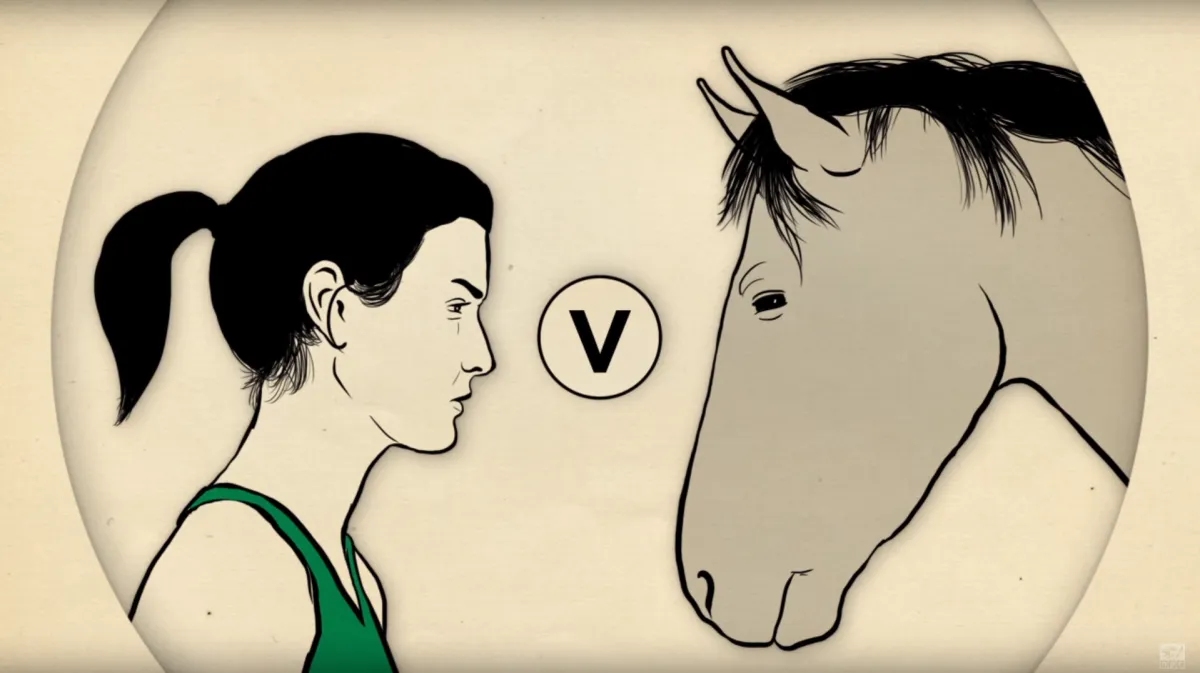 Photo: Man vs. Horse Marathon, via runningmagazine.ca
What We Lost Along the Way
So if humans are such remarkable endurance athletes, why does running a single mile feel impossible to most Americans? The answer lies in what evolutionary biologists call "mismatch theory"—our bodies evolved for one lifestyle but now live in completely different conditions.
For 99% of human history, covering long distances on foot was a daily necessity. Hunter-gatherers typically traveled 6-12 miles per day just for basic survival. Their children grew up running, walking, and moving constantly. Their bodies developed the cardiovascular capacity, muscle endurance, and movement efficiency that made multi-hour pursuits possible.
Modern life has essentially turned us into zoo animals—well-fed but confined to small spaces with minimal movement requirements. We've retained the biological machinery for incredible endurance, but we never develop it.
The Rediscovery Movement
Interestingly, some modern humans are accidentally rediscovering these ancient capabilities. Ultramarathon running—events of 50, 100, or even 200+ miles—has exploded in popularity over the past two decades. Participants often report that despite the extreme distances, these events feel more natural than shorter, faster races.
This makes perfect evolutionary sense. Humans weren't built for the anaerobic intensity of a 5K race. We were built for the steady, sustainable pace that could be maintained for hours or even days. Many ultrarunners describe entering a meditative state during long efforts—possibly echoing the focused mindset that allowed our ancestors to track wounded prey across vast landscapes.
Reclaiming Your Birthright
You don't need to chase antelope across the savanna to tap into your endurance heritage. Simply walking regularly begins to awaken dormant physiological systems. Gradually increasing distance and time on your feet—rather than speed and intensity—aligns more closely with how your body was designed to move.
The next time you feel winded after climbing a flight of stairs, remember: you're carrying the genes of creatures who could run down horses. Your cardiovascular system, your cooling mechanisms, and your biomechanical efficiency represent millions of years of evolutionary fine-tuning for exactly this kind of sustained physical effort.
We may have traded our endurance for elevators and our pursuit instincts for delivery apps, but the machinery is still there, waiting to be rediscovered. In a world that increasingly celebrates speed and intensity, perhaps it's time to remember that our greatest athletic gift was never about being fast—it was about never stopping.